Deep in December, Our Hearts Should Remember
A re-appraisal of Persuasion.

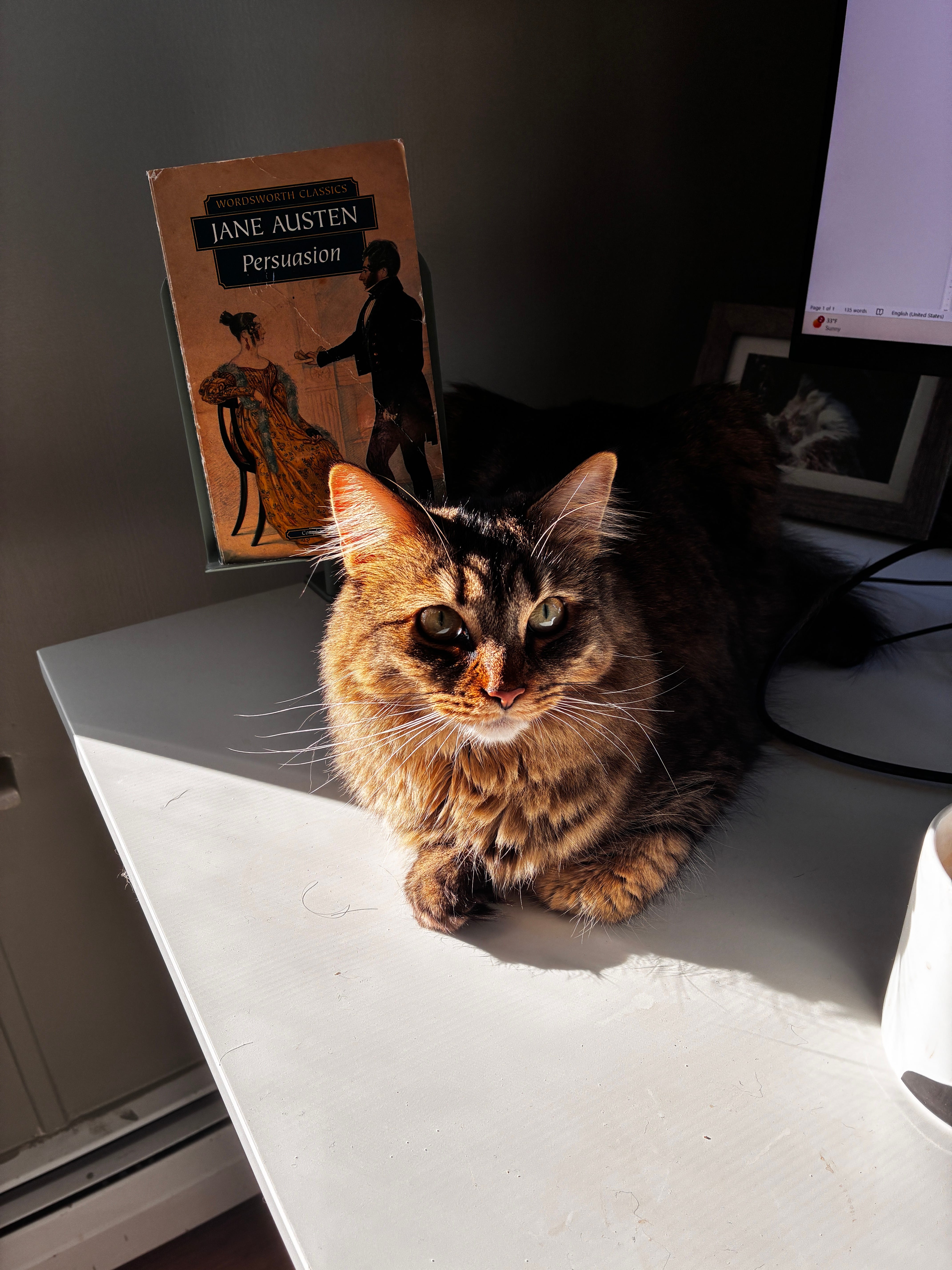
For my work book club, we are reading Persuasion. For those of you who haven’t read it, it tells the story of Anne Elliott, who, years before the books begins, fell in love with a young sailor named Frederick Wentworth. After a whirlwind romance, the two became engaged, but Anne was eventually convinced to end the engagement by Lady Russell, a dear friend of her late mother, who felt it was an imprudent match with an unknown entity. As the book opens, seven years have passed and Anne remains single and at the mercy of her narcissistic father, Sir Walter, and self-absorbed older sister, Elizabeth. Circumstances brings now Captain Wentworth back into Anne’s orbit and the main events of the book commence.
I was excited when it was chosen for the book club because I had read it — or read part of it – a few years ago as part of a different book club, but in a less-than-ideal state of mind. Just as the day of the book club approached, an incipient romance of my own was in the middle of imploding — I was literally on a hurt-angry bike ride trying to blow off some steam when I remembered we were meeting and had to join on my phone from a bench on the Eastern Trail — and I can’t say I was particularly objective, or even very engaged, with the novel itself. Mid-rejection, I certainly did not have much sympathy for Anne or her regrets. “She f*cked that guy over,” I thought, and may have actually said, regarding Captain Wentworth. To this day, I ride at dawn for poor Frederick.
Even on this read, it is hard to say whether I am projecting my own hangups about previous romantic disappointments onto a novel from the 19th century (quite likely) or whether Anne is, in fact, kind of insensitive and oblivious about her impact on Captain Wentworth. Like, bitch, you rejected him. And now you’re going to mope about the consequences? Near the end, as Captain Wentworth seems to soften towards Anne, and even hints at his lingering feelings for her, Anne is all bemused that he is possibly jealous of Mr. Elliott, her formerly estranged cousin who, in the book’s final third, starts dropping some hints he’d like Anne to, ahem, remain forever an Elliott. And it’s like, again, asshole, you broke off your engagement with him because he was not rich and titled, and now he sees you being chatted up by your widowed cousin who is rich and set to inherit your father’s estate. I’m really glad you find his pain CUTE.
And then Frederick has to put himself out there with his very literary “half agony, half hope” note. (He is my dude!) I’m not saying it’s not an accurate portrayal of how people are, I will not deny I am over-identifying, but I do really need her to be a little less up her own ass about the whole thing. (Update: I just re-read the concert scene — I am projecting! She is literally like “Ugh, god this dude will not stop talking to me and it is scaring Frederick away and probably making him sad.”) Even in the original discussion (which did get a bit sidetracked by the news of my in-process ghosting) there was general consensus that Anne was a less engaging heroine than, say, the Dashwood sisters or Elizabeth Bennett1. Persuasion is basically a book about a very functional depressed person, which, if you’ve ever spent much time in the company of such a person, you know it lacks pizazz.
All that said, I did find more to admire — or, at the very least, to relate to — in Anne this time around. That sense of loss and disappointment, of resigning one’s self to something other than what you’d hoped for or expected. I saw a bit of myself in the way she makes herself very useful — to her sister, Mary, who is a hypochondriac and all around downer but also to just about everyone in the vicinity of her family’s estate, Kellynch — and the way her own experience of loss/regret gives her particular insight into and compassion for the grief of others: notably Captain Benwick, a friend of Captain Wentworth’s whose fiancée died while he was at sea; her old school friend, Mrs. Smith, who has lost her health and her social position due to both cruel external circumstances and her own choices; and even, for a short time, before he is revealed as a villain, Mr. Elliott. The way that seeing them appreciate and admire her gives Anne some of her vitality back (or, as the book puts it, her “bloom”), and opens up possibilities that had long seemed foreclosed.
By the book’s end, she has the confidence and fortitude that she lacked all those years earlier when she was prevailed upon by Lady Russell to give Captain Wentworth up. Well before the book’s climactic note is hastily shoved into her hands, Anne has decided that she will never marry Mr. Elliott (whose poor character has not yet been revealed) despite his being Lady Russell’s new favorite and an easy solution to her family’s financial problems. She stills love Lady Russell and even values her opinion, but also sees her as someone with a foolish attachment to rank and hierarchy whose views are not superior to Anne’s own judgments. The Anne of the early parts of the novel would never have been so bold as to speak openly in front of Captain Wentworth about women’s enduring attachment to those they once loved. (That this counts as bold, however, is an indication of Anne’s overall passivity.)
Brandon Taylor wrote in Time that Persuasion is Austen’s most adult novel and that Anne and Frederick’s love is deeper and more tender because of their separation and the risks they must take to reunite — both chancing another, more final devastation. That they would have been “happy but unremarkable” had they stayed together all those years earlier. I can say for certain that the Frederick Wentworth who didn’t experience a shattering disappointment would be very different from the one we meet in the book. (As Lenny Briscoe once famously sang, in the song for which this post is named, “without a hurt, the heart is hollow.”) That Frederick Wentworth would not have been my dude. Based on the very few sentences that describe young Frederick, he seems frankly annoying.
I tend to think that, at the very least, their happiness in that other timeline is an open question. One cannot presume, after all, that everything else would have proceeded along the same course, that they would be basically where they are now, but together. After all, Wentworth’s success may be due to his own merits, but his wounded pride following Anne’s rejection was certainly part of his motivation. Absent her rejection, and with a wife to consider in his decisions, maybe he would not have found the same level of success, maybe he and Anne would have struggled, perhaps their happiness would have curdled into resentment and distance.
And then there is simply the matter of chance. There is a moment, early in their re-acquaintance, where Wentworth is talking to others of a creaky old ship that was his first commission. That he had only just exchanged it for a much sturdier French frigate when he was caught in a terrible storm. Had the storm happened only a few days earlier, he likely would have been lost at sea. Any change to the timeline would have reordered these events or completely scrambled them. That isn’t to say that, had he and Anne married as they had intended, she would have ended up a young widow, but there’s no way to say she wouldn’t have.
To bring a slightly Buddhist interpretation to things, one could say that, at their first meeting, the conditions were not present for their ultimate happiness: Wentworth was too callow and untested, Anne was lacking in confidence and resolve, and their union faced a great deal of opposition that would have made their lives difficult. As Anne herself says towards the end, she was right to accept Lady Russell’s counsel, given the circumstances at the time. Lady Russell was also not wrong to worry about Wentworth’s ultimate success or his long-term suitability as a husband. These decisions brought a great deal of suffering to both Anne and Wentworth (who is, to my mind, completely justified in his anger and hurt), but that does not make them necessarily wrong. And that suffering has given them depth and maturity they would never have attained otherwise. (Not that this ultimately good result makes the suffering worthwhile.)
Beyond that, some of the most vexing things about Anne’s existence — her vain, foolish father who, with her mother gone, is incapable of staying within his income — turn out to be the very means by which Frederick is brought back into her life. And now that Sir Walter has been brought so comparatively low, he can no longer have such strong objections to Captain Wentworth, anymore than he had to Admiral Croft, who took residence at Kellynch. (And, I’m sorry, that is the worst name of any of the estates in all of Austen’s novels.)
Beyond that, as Austen’s final and most mature work, it does feel somewhat kinder. Aside from Mr. Elliott, who still seems made of more realistic stuff than, say, George Wickham, there are very few villains in this novel. No one on the level of Mr. Bingley’s sisters or John Dashwood’s horrible wife or Mrs. Elton. While Louisa and Henrietta Musgrove are, for a time, Anne’s rivals, the book treats them with good humor and affection, just as Anne does. They, in turn, love Anne and wish she had accepted their brother’s proposal and been their sister-in-law instead of sad Mary. And while Sir Walter and Anne’s late mother are, like Mr. and Mrs. Bennett, another cautionary tale about the perils of marrying a hot person you don’t respect, the Crofts are a rare thing in Austen: a happy couple who genuinely love and admire each other. (Though, one could see equivalences in the Gardiners in Pride and Prejudice or the Westons in Emma2, both marriages where the men had to make, rather than inherit, their fortune.)
My coworkers did not particularly like this book — few of them even finished it, aside, I think, from our CFO. The 19th century language was alienating and there isn’t nearly as much sparkling dialogue as there is in, say, Pride and Prejudice. I think, with Austen, sometimes you need to be told that she’s being funny or you could just read it straight. For instance, if “It’s a truth universally acknowledged that a single man in possession of a good fortune must be in want of a wife” was not a very well known (and at this point pretty tired) witticism, you could just be like “True, true.” Anyway, Sir Walter obsessively reading his entry in the Baronetage is funny! “Retrench!” is funny!
She clearly outranks Fanny Price of Mansfield Park, however. (At least the book version. The 90s adaptation made Fanny into a writer (a proto-Jane, if you will) and also threw in some unexpected homoeroticism with Mary Crawford.)
I definitely have read Emma, but my primary reference remains the 1995 film with Gwyneth Paltrow. Not sure there will ever be another Mr. Knightley for me but Jeremy Northam.